How to set the redox level in a swimming pool?
Redox value, oxidation–reduction potential (ORP), pool ORP, redox probe

What is redox potential?
Redox potential in a swimming pool, also known as oxidation–reduction potential (ORP)—is an electrical value measured using a dedicated probe (redox probe). In private pools, this value, expressed in millivolts (mV), is used to assess the disinfecting capacity of the pool water.
The redox value indicates whether the pool water contains a sufficient and effective amount of disinfectant in relation to the level of contamination.
Oxidising (disinfecting) substances that increase the redox value:
- Disinfectants such as chlorine and bromine
Reducing substances (contaminants) that lower the redox value:
- Organic and inorganic impurities
- Oils, urine, sweat, bacteria, algae, leaves, etc.
In addition, redox potential is influenced by several water parameters, including total alkalinity (TAC), pH, stabiliser (cyanuric acid), water hardness, and water temperature.
Because of these multiple influencing factors, it is not possible to determine the exact chlorine or bromine concentration directly from the measured redox value. The disinfectant level must first be set to the desired target in the pool; the corresponding redox value can then be determined and used as a control reference.
How do you correctly set the redox value?
-
Determining the correct redox value
In different pools, the same chlorine or bromine level can result in very different redox values.
For example, a chlorine concentration of 0.8 mg/L may correspond to a redox value of 720 mV in one pool, but 780 mV in another.
The correct redox setpoint must therefore be determined individually for each pool.
-
Adjust total alkalinity (TAC) and pH level
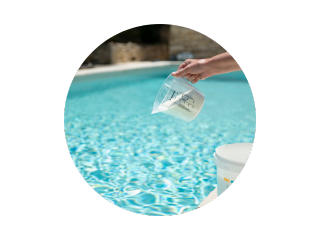
Total alkalinity (TAC) and pH both have a direct influence on redox potential measurement. Make sure the TAC is above 80 mg/L (using Alca-Plus® if necessary) and that the pH is within the ideal range of 7.0 to 7.4 (adjust with pH-Minus or pH-Plus).
-
Add stabiliser (cyanuric acid) for outdoor pools
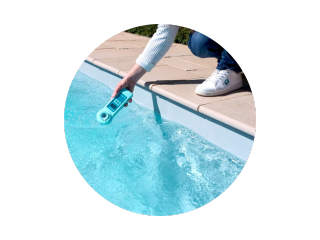
The stabiliser level (cyanuric acid) should be kept between 30 and 50 mg/L (Stabichloran®). If the level is too low, chlorine is poorly protected against UV radiation and degrades rapidly. Conversely, if the level is too high (above 75 mg/L), disinfecting efficiency can be reduced.
-
Set the chlorine or bromine level in the pool
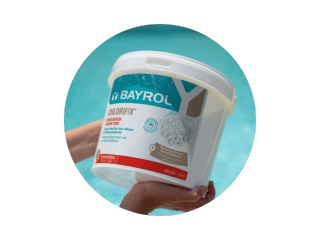
Set the desired chlorine or bromine level in the pool. For an outdoor pool (with stabiliser), free (available) chlorine should be between 1.5 and 3 mg/L. For an indoor pool, free chlorine should be between 0.6 and 1.2 mg/L.
Wait until the free chlorine level has stabilised, then verify the value using a photometer (Electronic Pooltester) before moving on to the next step.
-

Set the disinfection setpoint
Now note the value displayed on your device. This corresponds to the redox value of your water when all treatment parameters are correctly balanced.
To ensure your system maintains the optimal disinfectant level, enter this value as the disinfection setpoint. You can then carry out regular checks using a pool tester to verify that the parameters remain within the correct range. Please refer to your device’s operating instructions for the recommended frequency of these checks.


Practical example
Example: the target chlorine level in your pool is 1 mg/L.
First, adjust total alkalinity (TAC) with Alca-Plus® (> 80 mg/L), then adjust the pH to between 7.0 and 7.4 using pH-Minus or pH-Plus. Next, set the chlorine level in the pool to 1 mg/L by manually dosing chlorine granules (Chloryte®, Chlorifix®) or chlorine tablets (Chlorilong®, Chloriklar®).
If the stabiliser level in the pool exceeds 50 mg/L, prioritise the use of non-stabilised chlorine such as Chloryte®, in order to avoid further increasing the stabiliser concentration. If the stabiliser level is very low, Stabichloran® can be added.
After checking and confirming the chlorine level with a photometer (Electronic Pooltester) or a manual pool tester, note the redox value displayed on the device—for example, 680 mV.
We do not recommend using test strips, as they may lack precision.
Now set the displayed redox value (680 mV) as the redox setpoint for automatic regulation. This value corresponds to a chlorine concentration of 1 mg/L in the pool. The redox controller will then maintain the redox potential at this setpoint, ensuring a stable and consistent disinfectant level in the pool.
Frequently Asked Questions
-
Redox potential results from the oxidation and reduction of chemical substances. While the oxidation of chlorine, for example, releases electrons, reduction processes absorb them.
This creates an electron flow whose electrical potential can be measured by an electrode and is generally expressed in millivolts (mV).
This electrode is integrated into automatic dosing systems and, based on the measured voltage value, can adjust disinfectant dosing in response to changes in water quality.
-
As part of automatic water treatment, dosing systems can use redox potential to quickly adjust disinfectant dosing in response to changes in water quality.
However, redox potential alone is not sufficient to accurately assess overall water quality. The redox reading is strongly influenced by several key parameters, including pH, total alkalinity (TAC), cyanuric acid (stabiliser) and water temperature.
For reliable redox regulation, we recommend the following target values:
- pH: 7.0 – 7.4
- Total alkalinity (TAC): > 80 mg/L
- Cyanuric acid: 30 – 50 mg/L
Maintaining these parameters within the recommended ranges ensures stable redox control and effective, consistent disinfection.
-
When calibrating redox potential measurement, a buffer solution with a known redox value is used (for example 465 mV).
Depending on water quality and the condition of the electrode, a redox probe may react very slowly when switching from the buffer solution back to pool water after calibration.
In unfavourable conditions, this run-in period can last several hours before the measured redox value stabilises and is displayed correctly again. During this stabilisation phase, it is not possible to properly adjust or commission redox regulation.For this reason, redox calibration should only be carried out when truly necessary, for example if a defective electrode is suspected.
In many cases, calibration can be avoided to prevent issues caused by long stabilisation times, for the following reasons:
- A correctly functioning redox electrode usually operates within a very narrow tolerance range, so calibration typically changes the displayed value by only a few millivolts.
- The absolute redox value is not critical. What matters most is correlating the redox value with the actual chlorine level in the pool (see the section Determining the redox setpoint).
Step by step
- Shut off the sample water supply
- Disconnect the electrode cable from the device
- Unscrew the redox electrode from the measuring chamber
- Rinse the redox electrode with (distilled) water
- Carefully dry the electrode by gently dabbing it with a clean, grease-free and lint-free cloth
- Reconnect the electrode cable to the device
- Select 1-point pH calibration in the menu
- Enter the redox value of the buffer solution as the calibration value (e.g. 465 mV)
- Immerse the redox electrode in the buffer solution (e.g. 465 mV) and gently stir for a few seconds
- Once the displayed measurement has stabilised and no longer changes significantly, confirm the calibration by pressing Next
- Check the calibration results displayed and complete the calibration by pressing Finish
- Reinstall the redox electrode in the measuring chamber
- Open the shut-off valves for the sample water
This procedure ensures accurate calibration while minimising unnecessary downtime caused by extended stabilisation periods.
-
A redox value that is too low indicates insufficient disinfectant in the water. There are two ways to increase it:
1. Activate Boost mode or continuous manual production
Enable Boost mode or continuous production (depending on the model). This temporarily increases chlorine production or injection, which raises the redox value.
2. Add disinfectant manually
Carry out a shock chlorination using shock chlorine products such as Chlorifix®, Chloryte® or Chloriklar®, or place chlorine tablets in the skimmer (Chlorilong®). This approach is particularly recommended after heavy rainfall, intensive pool use, or when the water becomes cloudy.
Checks to carry out:
- Measure the chlorine level using a Pooltester or Electronic Pooltester.
- Outdoor pool (with stabiliser): 1.5–3 mg/L free chlorine
- Indoor pool: 0.6–1.2 mg/L free chlorine
- Once the chlorine level has stabilised, note the redox value displayed by your device. This value becomes your redox setpoint.
There is no standard redox value, as it depends on each pool and its specific parameters (pH, TAC, stabiliser level, temperature, etc.).
- Measure the chlorine level using a Pooltester or Electronic Pooltester.
-
There is no universal redox value, as it depends on many parameters (pH, temperature, stabiliser level, type of disinfectant, probe used, etc.).
In practice: in a well-balanced pool, the redox value generally lies between 650 and 780 mV. What matters most is determining the value that corresponds specifically to your target chlorine level.
Example: if 1 mg/L of free chlorine corresponds to 700 mV in your pool, then 700 mV becomes your redox setpoint. Always check free chlorine regularly using a Pooltester or Electronic Pooltester, as it is free chlorine that ultimately guarantees effective disinfection.


