The 4 care steps from BAYROL
POOL MAINTENANCE SIMPLY EXPLAINED

The regular maintenance of your pool is based one 4 steps that guarantee good quality, clear and healthy water. Follow these simple steps and bathe in crystal clear, hygienic pool water.
1/ Water balance
Why?
Water balance or pH regulation is the basis of pool water maintenance. It is the first step to clean pool water and optimal bathing comfort. The ideal pH value is between 7.0 and 7.4. If the pH value is outside the recommended range, this can lead to skin and eye irritation as well as damage to built-in parts. All further maintenance steps are also less efficient. Inseparably linked to the adjustment of the pH value is the adjustment of the carbonate hardness or also alkalinity (TA value). An unstable pH value can be caused by a low alkalinity (TA value below 80 mg/l). A well adjusted TA value therefore prevents fluctuations of the pH value and ensures a stable water balance.
When?
If the pH is outside the recommended range of 7.0 - 7.4*, and the TA is below 80 mg/l. Check the pH at least once a week. *7.0-7.6 when maintained with bromine.
Products to balance pH
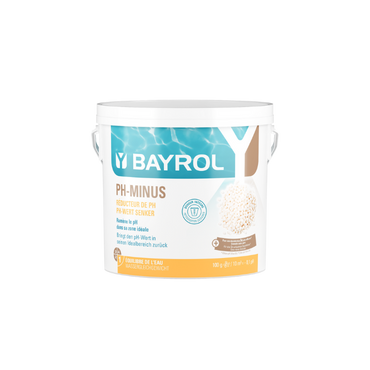 Granules for lowering a pH-value above 7.4. Exact dosing through an enclosed dosing cup.
 Granules for increasing a pH-value below 7.0. Exact dosing possible through an enclosed dosing cup.
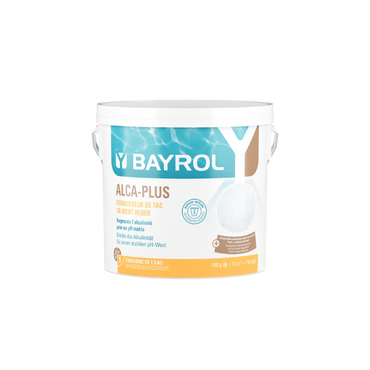 Granulated pH regulator for swimming pools. Dissolves quickly, correcting pH instability caused by low alkalinity. Prevents pH fluctuations and reinforces water balance.


2/ Water disinfection
Why?
In addition to balancing the water, water disinfection is an essential step in pool maintenance to remove contaminants such as bacteria and microorganisms from the water. Without the addition of a disinfectant, the water will very quickly become cloudy and unsightly, and swimming will no longer be safe.
Disinfection with chlorine is the best known method. However, there are alternative methods such as disinfection with active oxygen or bromine.
When?
The pool water must be continuously disinfected throughout the swimming season. If there are problems (algae, cloudiness, slippery deposits), perform shock disinfection. Keep the chlorine content always between 0.5 and 1 mg / l.
Permanent disinfection methods and SUITABLE PRODUCTS:
- Chlorine: Chlorilong® CLASSIC, Chlorilong® POWER5, Chlorilong® ULTIMATE7
- Active oxygen: Soft&Easy
- Bromine: Aquabrome®
Shock disinfection methods and SUITABLE PRODUCTS:
- Organic Chlorine: Chlorifix® or Chloriklar®
- Inorganic Chlorine: Chloryte®
Disinfectants for disinfecting pool water
 Slow dissolving 250 g chlorine tablets for permanent disinfection. Ensure clean and disinfected water.
 Slow dissolving 5-function chlorine tablets for permanent disinfection. Ensures pure, crystal clear water and prevent damage to the pool surface.
 Two-phase 300 g chlorine tablet with 7 functions for optimum and long-lasting disinfection of pool water and filter.
 Granular blend based on active oxygen for disinfection, algae prevention and clarifying effect.
 High-quality chlorine granules for shock treatment in case of water problems. Quickly and effectively increases the active chlorine content. Less dust due to the special granular form.
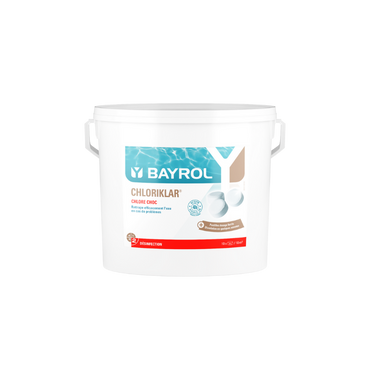 Chlorine effervescent tablets for shock treatment in case of water problems. Fast dissolving and easy to dose.
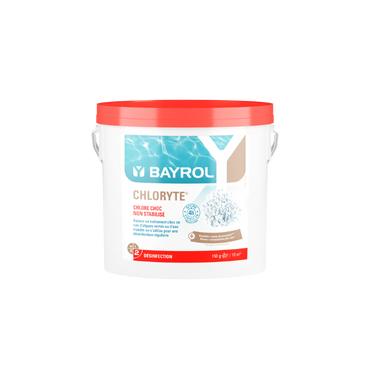 Pure, inorganic chlorine granules without stabilizer, for shock treatment in case of green or cloudy waters. Quickly and effectively increases the active chlorine content. Immediate effect.


3/ Algae prevention
Why?
Even continuous water disinfection is not always enough to prevent the spread of algae in the pool. Therefore, prevention is necessary to prevent or slow down the growth of algae. Algae can spread very quickly via spores carried into the pool by the wind, and encourages the growth of bacteria and fungi. In addition, slippery algae coverings can cause accidents.
When?
Add an algaecide to the pool water on a regular basis to prevent algae formation, especially during sunlight and heat, as these are particularly conducive to growth. The formation of algae is much easier and cheaper to prevent by preventive measures than to have to remove them later laboriously from the pool again.
Products for combating algae and phosphate


4/ Flocculation
Why?
Flocculation ensures crystal clear water in your pool. Cloudy water is a phenomenon that occurs in every pool at some point. The tiny particles suspended in the water are responsible for this. Most filters are not able to filter out these very fine particles. The result: the water becomes turbid. By the flocculant these finest particles are summarized and wrapped up in a "flake", and are thereby enlarged and made filterable. They are then finally and effectively removed from the filter during the next backwash.
When?
Continuously, throughout the swimming season. The use of a flocculant is recommended only for sand or glass filters. For pools with cartridge filters, we recommend the use of a clarifier.
Flocculants and clarifiers


FAQ
-
A shock treatment, or shock disinfection, quickly and effectively eliminates impurities and micro-organisms in the water, such as algae, bacteria and viruses. Your pool needs shock treatment:
- At the start of the season, to disinfect the pool water and then easily maintain the disinfectant level.
- As a preventive measure, once a month or more, in the event of very hot weather or heavy use of the pool, to prevent damage.
- When the pool is closed to purify the water.
- In the event of water problems, green or cloudy water....
-
This is the question that all pool owners ask themselves. To keep your pool water clean and of high quality, you need to..:
➡ clean the pool physically and thoroughly,
- measure the pool water parameters regularly,
- maintain pH, TAC and disinfectant levels (chlorine, bromine) within recommended ranges,
- conduct chemical treatment through 4 stages: 1. Water balance 2. Disinfection 3. Algae control 4. Flocculation/clarification.
Also remember to adjust your filtration time according to the temperature of your water: filtration counts for 80% of water treatment! You need to keep your filter (sand filter, cartridge filter or diatomaceous earth filter) well maintained to ensure that the pump and filtration system operate at optimum efficiency and wash it regularly. Regular maintenance is the absolute key to a trouble-free bathing season.
-
The more regular and frequent the pool maintenance is, the less time it takes and the more likely you are to avoid water problems. The best way to keep your water clear and clean all year round is to maintain your pool regularly, even during the winter.
During the bathing season, you'll need to treat your pool once a week, following the 4 main treatment steps in order. At the height of summer, clean your pool daily, and analyse your water several times a week (2 or 3 times if it's very hot). This will ensure that your water is of the highest quality and that your bathers are as comfortable as possible.
-
Do you have a salt electrolysis system? Automatic SALT, the connected salt water system from BAYROL Technik, regulates the pH and chlorine production for you to ensure impeccable water quality. Regulate your TAC at the start of the season. During the season, carry out a preventive anti-algae treatment and flocculate.
-
Do you have an above-ground swimming pool (volume less than 15 m3)? Its water is just as subject to the vagaries of the weather and external aggression (algae growth, micro-organisms) as any other pool. Knowing that the dosage of treatment products depends on the volume of water in the pool and that the precautions for use formally mention not breaking or cutting the pebbles, use the SpaTime range, with its smaller pack sizes better suited to the size of your small pool.


